The trade magazine OFFICE ROXX asked Peter 50 questions: ranging from highly technical to very personal.
Life Takes Place Between Things
OFFICE ROXX: 50 questions for Peter Ippolito
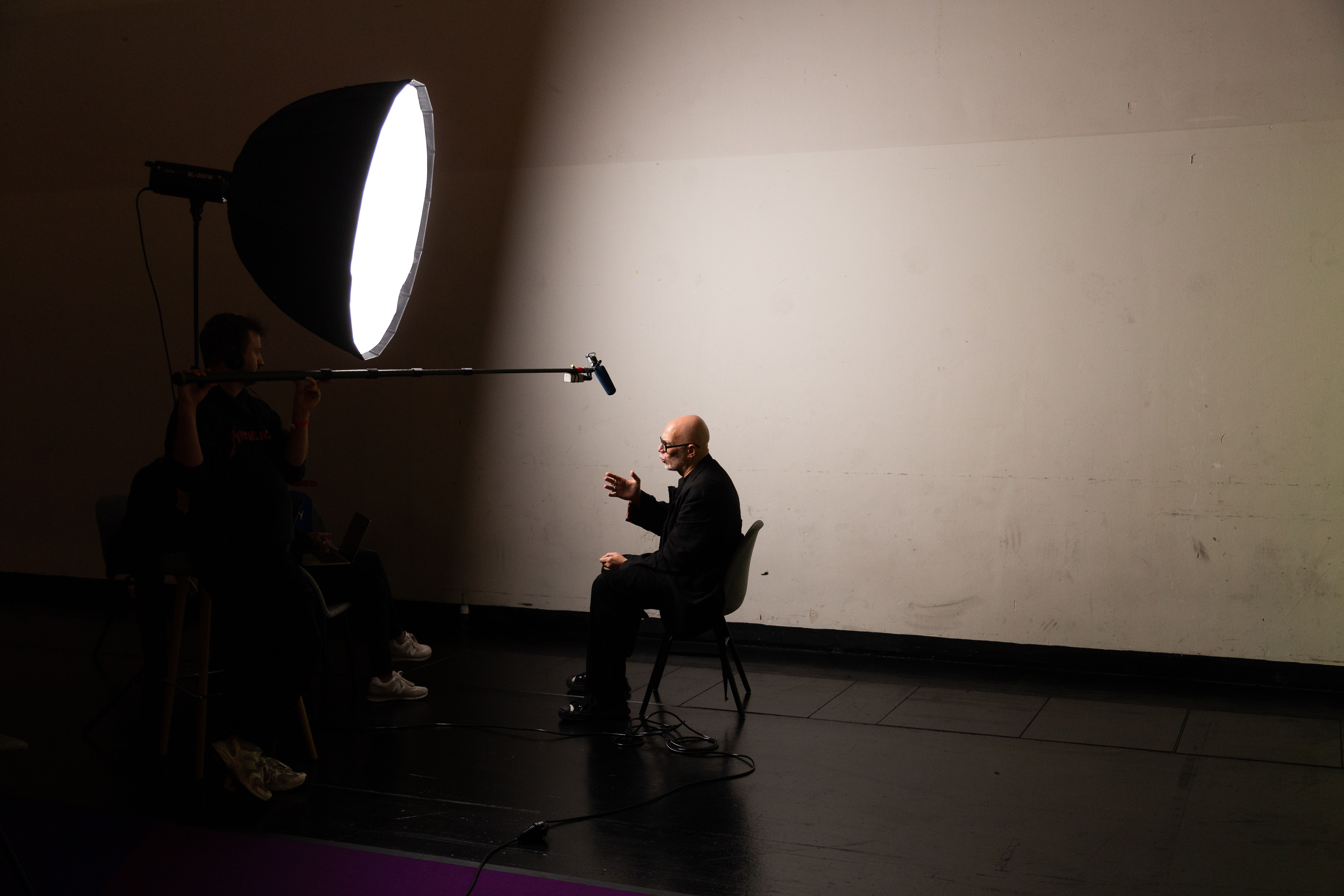
The trade magazine OFFICE ROXX asked Peter 50 questions: ranging from highly technical to very personal.
1. Please describe your workplace.
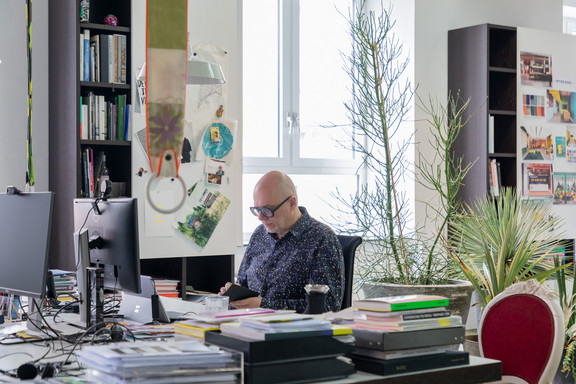
When I’m in Stuttgart, I have a desk in our open-plan office. Otherwise, I use my phone and laptop when I’m out and about.
2. How do you get to work?
By car.
3. Where do you prefer to work?
With people.
4. How many video calls do you have per week, and how much time do you spend on them?
About 20%. But I try to have face-to-face conversations as much as possible.
5. On average, how many hours per week do you spend on social media channels?
Seven hours.
6. How many hours do you work on average per week?
60 hours.
7. What inspires you when you come up with new ideas?
Travel, art and, above all, the privilege of constantly meeting new people and hearing their ideas from all over the world.
8. What are your three favourite projects from the Ippolito Fleitz Group?
I don’t have any. I don’t think in terms of rankings. However, there are certainly projects that have had an impact on us and our self-perception: the Palace of International Forums in Tashkent, the Spiegel canteen, and the Beiersdorf Global Workspace.
9. The following three office projects by other interior designers are also worth mentioning:
Second Home in L.A. by Selgascano
Bloomberg London by Foster
Nike One Central HQ by Kinzo.
The fact that publications almost exclusively feature informal working opportunities speaks volumes about societal desires rather than the reality.
10. How has the Ippolito Fleitz Group weathered the crises since 2020? What has been and continues to be particularly challenging?
Although we saw the pandemic as an inspiring state of emergency, the following years, with their payment defaults, insolvencies and subdued yet highly volatile markets, have been quite challenging. However, we have always had the advantage of having a strong foundation, and not just for content-related reasons. If one area, region or discipline is experiencing difficulties, others can compensate for it. This, coupled with our fundamentally optimistic and agile approach, has certainly worked in our favour in recent years. We find balance through new international markets or by expanding our scope of services. However, we are currently seeing fees under severe pressure worldwide, accelerating the search for efficiency-boosting tools such as AI and the possibility of strategic outsourcing.
11. For several years now, the office and home furniture sectors have been merging. Will we end up working only on sofas and armchairs in the office?
The fact that publications almost exclusively feature informal working opportunities speaks volumes about societal desires rather than the reality. Both types of work have their place in a collaborative environment and should not be pitted against each other. Finding the right balance depends on a company’s culture, organisation, and vision.
12. What was your impression of the Orgatec 2024 office furniture trade fair?
It was good to see that the fair had more momentum than the smaller post-Covid version. There was more optimism and energy.
13. In Germany, there are also signs of a decline in office space, as well as new core tasks for the corporate office in some areas. What is your view on this?
Ideally, the office is where I can experience the company’s culture, identity, purpose and vision authentically in everyday life. It is a place of belonging and appreciation, and it provides those moments that are difficult to experience virtually, such as encounters, collaboration, agile dynamics (especially the spontaneous ones), shared energy, mutual understanding and inspiration. It is a place, or rather an idea, that is much bigger than a collection of desks.
14. What has happened to all the desks? Modern office projects sometimes resemble showrooms or flagship stores. But where can ordinary screen work be carried out?
As previously mentioned, desks are, of course, still an integral part of the working world. However, they may no longer be at the centre of things, as work has evolved massively. When innovation in knowledge work is primarily fuelled by collaboration and communication, expanded workplaces emerge. Whereas work used to take place in static spaces, today spaces follow the constantly changing demands of work. In the next transformation process, which has just begun, AI will further accelerate this development.
No-gos are never sensible.
15. The individual office has become something like the old white man of office designs. Some architects reject its existence outright. However, surveys still show that office workers would prefer to work there. How can this conflict be resolved?
No-gos are never sensible. The truth usually lies somewhere in between. But it’s also true that employees’ preferences are often influenced by habits and concerns about change. In successful working environments, there are no preconceived opinions, only hopefully a good, sincere transformation process. The process is often more important than the result itself. To quote Bill Clinton: ‘It’s the people, stupid!’
16. Or are cubicles the new individual offices? At Orgatec, there was an entire hall consisting almost entirely of telephone booths. Is this the future of office work? Cubicles that are only closed at the top?
Of course, open-plan offices also need areas where employees can retreat. However, if this results in employees spending the entire day in a telephone booth the size of a server cabinet, then the project has failed.
However, this discussion is too simplistic. The difference between traditional office cubicles and open-plan spaces is not just the new form, but also the fact that the latter are easily changeable. This is invaluable in an age of constant change. The same applies to the fact that work no longer revolves around one’s own desk statically.
17. How might the traditional role of the architect evolve?
With an expanded understanding of their role, architects are likely to become design strategists, combining creative vision with technological, sociological and data-driven expertise.
18. One of the biggest mistakes interior designers make is...
In Germany, it is often a lack of self-confidence in their role and the value they add to people’s lives.
19. How colourful can an office be?
Design always stems from identity and a relevant concept. Anything goes, as long as it is relevant.
20. How do you imagine offices will look in 2040?
Hopefully they will be very different from today’s offices. In a positive scenario, they will be fluid, hybrid and adaptive, blurring the boundaries between life and work. They will be intelligent and responsive, with invisible, user-centred technology. They will be a space of possibilities, giving users a strong foundation and the freedom to develop themselves and their work in whatever way makes sense to them.
Life takes place between things.
21. What have you always wanted to say about the development of interior design?
Oh my, there’s a lot that could be written about that! Perhaps it’s worth noting here that, in our view, good interior design shapes things; however, the goal is not the design of things, but the quality of what happens in between. After all, life takes place between things.
22. How will AI transform the architecture industry?
Fundamentally. Just as it has in every other industry. The focus will shift significantly from production and processing to conception, strategy, cross-functional networking and managing complex technological and knowledge contexts. This will not only change job descriptions, but also the number of people needed for roles, particularly in traditional mid-level positions. This is exciting, but will be extremely challenging for society. At the same time, the tool opens up new opportunities within architecture itself.
23. What is your opinion on ecological sustainability?
It goes without saying.
24. What do you think of the concept of ‘New Work’?
In my opinion, the term is poorly chosen. Work is always new because it is constantly evolving. This also means that the answers and contexts we create are constantly changing. That’s what makes it so exciting, especially now, in a phase of rapid change in almost all areas of our lives. This is especially true now, in a phase of rapid change in almost all areas of our lives.
25. My advice to Gen Z is...
Find your own way with confidence and energy. Don’t wait for anyone or anything. Nothing will be handed to you on a silver platter, but you can achieve anything. Do what you want to do and don’t worry about what I would advise.
I love it!
26. What are you currently working on?
I am working on myself and a wide range of diverse projects of various types for different client groups of various cultural backgrounds and on various scales. I love it!
27. What is your greatest professional success?
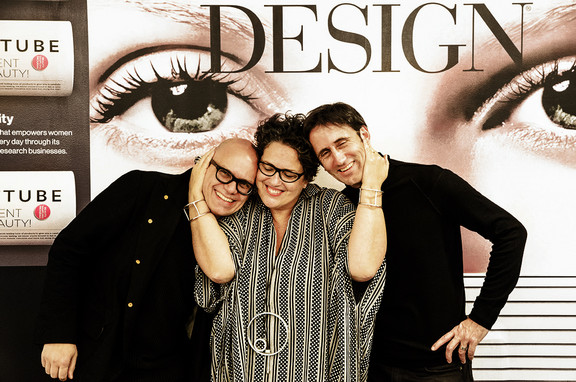
Being inducted into the Interior Design Hall of Fame in NYC.
28. What has been your biggest failure?
Work/life is a learning process. That’s why we don’t really think in terms of failure. Of course, you lose competitions, and sometimes a project doesn’t have the desired effect. But that’s all part of the job. What’s more relevant are failed relationships with people. Whether with colleagues or customers.
29. Insta, LinkedIn, or...?
Both.
30. Do you still read printed material?
Of course — I love books!
31. If you were ‘King of Germany’, what would you change first?
Bureaucracy, regulatory madness and digital transformation.
32. What would you like to be able to do?
Sing.
33. Where would you most like to live?
On the road.
34. What helps you to relax?
Cooking and hiking.
35. What did you originally want to be when you grew up?
Chancellor of Germany.
36. What are your main character traits?
Direct, curious, courageous and solution-oriented.
37. What is your superpower?
My energy.
38. What are your hobbies or passions?
Cooking and eating.
39. What three things would you take with you to a desert island?
I don’t want to go there! So, I would take my husband, my phone and my friends.
40. Who is your favourite artist?
I don’t understand the point of “favourite” questions. I just don’t think that way. The moment is always so much more exciting than longing for heroes. I recently discovered an extraordinary Japanese photographer: Daisuke Yokata.
41. What’s your favourite book?
Many. A few of my most memorable ones are Orlando by Virginia Woolf, Atemschaukel by Herta Müller, The Master and Margarita by Bulgakov, American Pastoral by Philip Roth and The Wind-Up Bird Chronicle by Murakami.
42. What is your favourite dish?
I don’t have one. However, dishes that take me on a culinary journey touch me. Or ones that simply bring back memories.
43. What is your favourite drink?
Champagne.
44. What is your favourite piece of wisdom?
The master in the art of living makes little distinction between his work and his play, his labor and his leisure, his mind and his body, his education and his recreation, his love and his religion. He hardly knows which is which. He simply pursues his vision of excellence at whatever he does, leaving others to decide whether working or playing. To him, he is always doing both.
45. Do you have a motto in life?
Just do it.
46. Electric car or combustion engine? E-bike or...?
E-bike, hybrid car.
47. Which sports club do you support?
None.
48. Which band would you like to see in concert?
I recently saw Kraftwerk, and I’m looking forward to seeing Ca7riel and Paco Amoroso.
49. Beach or mountains?
Beach.
50. And what kind of watch do you have: analogue or digital?
None at all.