The new THE CREATIVE LÄND campaign, run by MFG Baden-Württemberg, showcases the diversity, innovation and strength of Baden-Württemberg as a creative hub. The series opens with an interview with Peter. In 'Made Here', he discusses how our design studio is driven forward by regional roots and international projects.
Anyone entering the head office of the Ippolito Fleitz Group in the west of Stuttgart immediately recognises that working environments here are innovative and people-centred: bright communication zones instead of offices; various prototypes and materials made of fabric, stone or wood in the Material Lab; and vertical planting from the high ceilings in the creative jungle. And it's not just in Baden-Württemberg: the Stuttgart-based architecture firm realises projects in a wide variety of locations worldwide.
With offices in Berlin and Shanghai, Managing Director Peter Ippolito enjoys the balancing act between locality and internationality that his work involves. ‘My office partner Gunter and I studied and lived together in Stuttgart before founding the company in 2002. For us, our curiosity about people’s lives and our openness to the world has always been balanced with our deep personal, social and economic roots here.’
As a company, you are always better off when you are in a strong competitive field.
One of the main reasons for the connection to the location is the SME sector, which plays a particularly important role in Baden-Württemberg. ‘There are many people here who are genuinely passionate about what they do and will wholeheartedly support you if they believe in you. Unlike large corporations, where decision-making processes are often lengthy and complex, long-term, trusting partnerships are formed here. It’s a very personal business — and that's exactly what we value.’
For Peter Ippolito, Baden-Württemberg is not only home, but also an engine for innovation, particularly due to the vibrant creative scene and network of highly skilled professionals. ‘As a company, you are always better off when you are in a strong competitive field. Good companies attract good people. That gives you a good incentive to want to be better,’ says Ippolito.
New Work: an attitude and a design
For the Ippolito Fleitz Group, ‘New Work’ is more than just a trend; it’s an attitude reflected in every project. ‘Today, work is no longer tied to a desk, but to what I do. The design of working environments must reflect the fact that work is constantly changing.’ Designs must be flexible and adaptive, always putting people at the centre.
The office’s approach to projects is strongly characterised by international experience. ‘In Germany, we think about it for ten years and then get it right, whereas in Asia, you do it ten times until it's right, by which time you will have realised ten projects. You could have a long debate about which approach is better. But you don’t have to, because it’s anchored in the culture.’
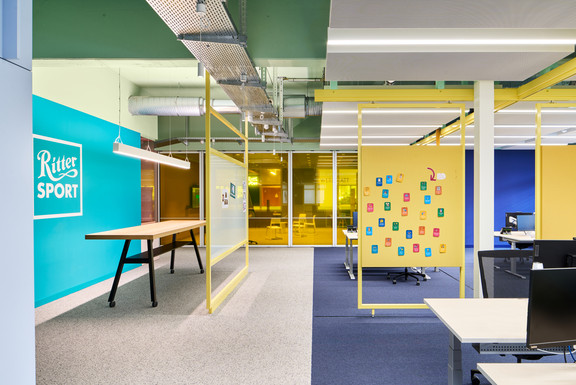
Projects such as the design of Beiersdorf’s global headquarters in Hamburg, which involved the entire workforce, and the expansion of the Ritter Sport headquarters in Waldenbuch, with its open and playful design that enables new forms of work, demonstrate the diversity of Ippolito Fleitz’s New Work approaches.
Architecture in transition: spaces that live and change
According to Ippolito, the role of New Work architecture is also changing fundamentally. ‘The office is particularly important today because unplanned encounters and coincidences take place there. How can knowledge be increased through what cannot be planned? And how can this unplanned aspect be organised? The office becomes a place where a company’s identity, culture and values are revealed,’ he explains.
Structural flexibility through modular elements, change management, and technological innovations such as artificial intelligence are important building blocks. The challenge lies in creating spaces that fulfil these needs while also being sustainable.
Customised solutions for different cultures
Ippolito Fleitz tailors his concepts to the specific needs of each client and their working culture. ‘We don't have a signature style that is the same for everyone. We say that the project we’ve never done before in a country we’ve never been to is always our favourite project. But each of our clients deserves a unique response.’
For example, a culture of presence is strongly anchored in Shanghai, while decentralised forms of work are widespread in the USA. Technical equipment, interior design and corporate culture must be harmonised to create productive working environments. ‘For instance, we design hybrid meeting rooms where people who are connected sit at head height opposite those who are present. We support our customers with hybrid meeting rooms, flexible spaces, and change management processes that actively involve employees,’ explains Ippolito.
Creative industries in Baden-Württemberg: a vibrant ecosystem
The variety and pioneering spirit of the creative industries in Baden-Württemberg is reflected at Ippolito Fleitz in particular as a creative network. ‘One major advantage here in Stuttgart is that we have three excellent universities. This means that there are many well-trained specialists, including in areas such as scenography and communication. This is enormously valuable. The high density of excellent creatives facilitates mutual exchange and creative inspiration,’ says Ippolito.
The office relies heavily on cooperation and dialogue with local players, such as those from the communications, advertising and graphics industries. ‘We build on networks, but we don’t rely on external support — we act on our own initiative,’ explains Ippolito. ‘At the same time, we have observed that other countries often react more quickly and flexibly to new developments, whether in terms of funding structures, digital tools, or collaboration between disciplines.’
Ippolito sees Baden-Württemberg as the future
Even if offices around the world are increasingly operating on an equal footing, the Stuttgart location remains an indispensable anchor for the company. ‘I would always prefer to have a strong location with many good players than be the only beacon with no incentive,’ says the managing director.
One thing is clear for Ippolito Fleitz: Baden-Württemberg is not only home, but also an important success factor as a creative location — and that’s why he wants to stay in Stuttgart: ‘We have strong emotional and economic roots here. At the same time, Stuttgart has always been a good base from which to look out into the world. I think that’s part of the energy of the Ländle, and it works well here.’